Insights
The Hidden ROI of Conference Intelligence: What Early-Mover Pharma Teams Are Seeing
Conference Intelligence is about more than collecting abstracts and tracking competitors. Discover how early-mover pharma teams turn conference insights into better decisions, identify emerging opportunities, and gain a strategic advantage.
ConfXcel Team·26 Oct 2026· 7 min read
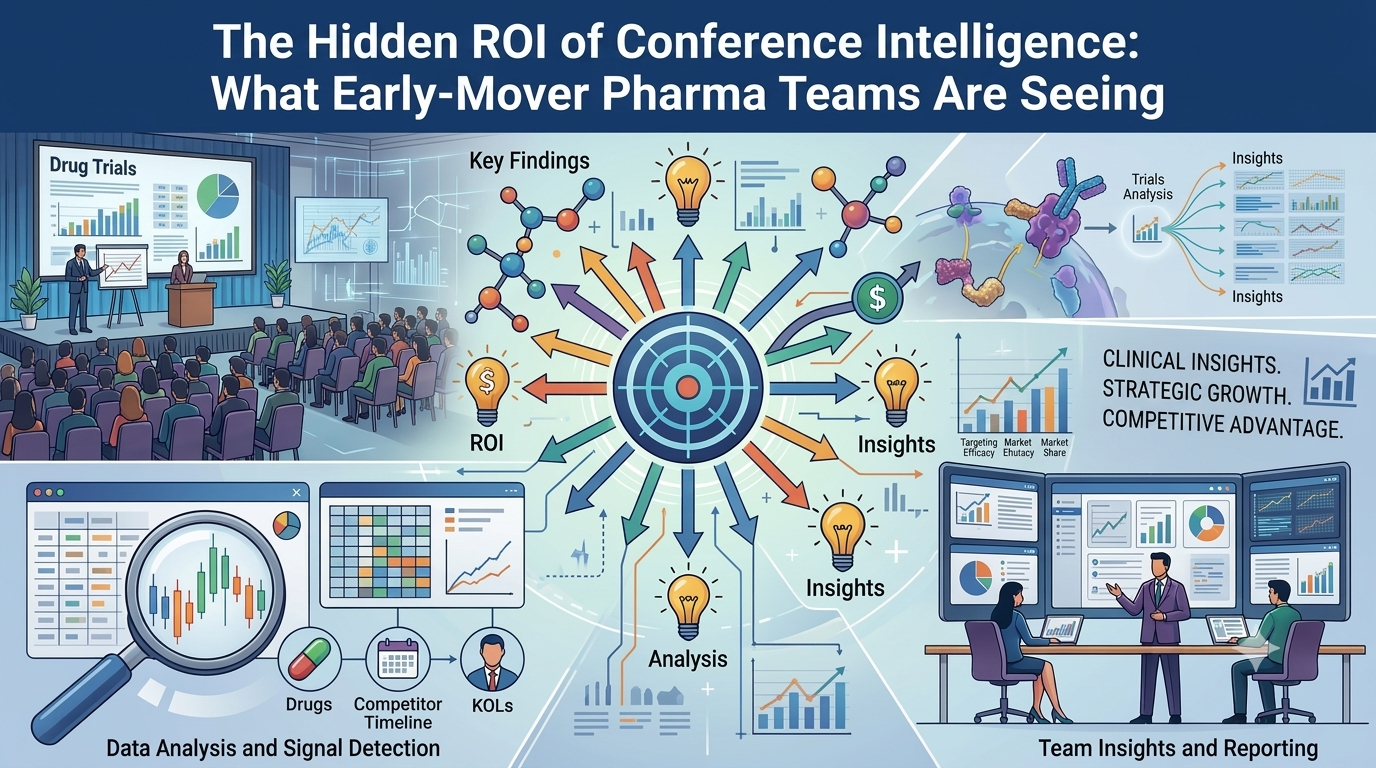
In the pharmaceutical industry, conferences are more than a place to present research, meet experts, and discuss new developments. They are also where important signals about competitors, emerging therapies, clinical research, and future market opportunities begin to take shape.
Yet, many pharma teams still treat conferences as one-time events. They collect abstracts, attend sessions, take notes, and prepare reports after the event. While this captures the obvious information, it often misses something more valuable: what that information can tell them about their next move.
This is where conference intelligence comes in. For early-mover pharma teams, the real return on investment (ROI) is not limited to the information collected during a conference. It lies in how quickly that information is turned into useful insights and decisions.
Beyond Attendance: Understanding the Real Value
The success of a conference is often measured by attendance, networking opportunities, or the number of presentations reviewed. These measures are useful, but they do not tell the whole story.
Consider a competitor presenting new clinical data in a therapeutic area where your company is also developing a product. The abstract itself may contain familiar information, but a closer look at the study design, patient population, endpoints, and reported outcomes could reveal a change in the competitor’s development strategy.
That insight may help your team reassess its own research priorities, prepare questions for upcoming expert discussions, or identify areas where further evidence is needed.
The value comes from connecting individual pieces of information to a larger strategic picture.
For pharma teams, conference intelligence makes this possible by bringing together scientific findings, competitor activity, expert participation, and emerging research trends in a structured way.
1. Getting Ahead of Competitor Moves
One of the most important benefits of conference intelligence is the ability to spot competitor activity before it becomes widely discussed.
A single abstract may not reveal much. However, when a company repeatedly presents research on a particular mechanism, expands into new patient groups, or reports progress across related clinical studies, a pattern begins to emerge.
These patterns can help teams understand where competitors may be directing their resources and attention.
Early-mover teams do not wait for a product launch or a major corporate announcement to begin asking questions. They monitor the smaller signals that may indicate a change in direction.
This does not mean every presentation predicts a future strategy. Rather, it gives teams an earlier opportunity to investigate, validate, and prepare for possible developments.
The ROI is often found in the time gained between identifying a signal and responding to it.
2. Making Better Use of Scientific Information
Pharma conferences generate a large amount of scientific information in a short period. Reviewing every abstract and presentation in isolation can quickly become overwhelming.
Conference intelligence helps teams focus on what matters most to their business and research priorities.
Instead of simply collecting publications, teams can compare findings across studies, examine differences in endpoints, identify unanswered research questions, and assess how new evidence fits into the existing scientific landscape.
For example, if several research groups begin investigating a similar therapeutic approach, this may indicate growing scientific interest in that area. If one competitor reports encouraging results while others focus on different endpoints, the contrast may raise useful questions about clinical positioning and evidence generation.
These observations help teams move from information overload to focused analysis.
Over time, this approach can also reduce duplicated research efforts and make internal discussions more productive.
3. Recognizing the Importance of KOL Activity
Key opinion leaders (KOLs) play an important role in shaping scientific discussions, clinical practice, and the wider perception of emerging treatments.
Their conference participation can provide useful context for understanding how a therapeutic area is evolving.
Which experts are presenting new data? Who is participating in discussions around a particular mechanism of action? Are familiar experts shifting their research focus, or are new voices gaining visibility?
Individually, these observations may have limited significance. When tracked over time and considered alongside published research, they can help teams identify emerging areas of scientific interest and potential opportunities for expert engagement.
This is especially useful when preparing for future conferences, medical affairs discussions, or scientific exchange.
The objective is not to assume that an expert’s participation signals support for a particular product. It is to understand the scientific conversations taking place and identify where meaningful engagement may be valuable.
4. Reducing the Cost of Delayed Decisions
One of the less visible costs in pharmaceutical competitive intelligence is the delay between information becoming available and a team acting on it.
When conference findings are reviewed weeks after an event, opportunities for timely follow-up may already have passed. Competitor developments may have been overlooked, important expert discussions may have been missed, and internal teams may have moved forward without considering relevant new evidence.
A more organized intelligence process helps reduce this gap.
By identifying priority sessions in advance, tracking relevant presentations during the event, and sharing concise insights soon afterwards, teams can make information available when it is most useful.
This does not necessarily require a larger intelligence team. Often, the improvement comes from having clearer priorities, consistent monitoring methods, and a defined process for communicating findings.
Time saved is only one part of the benefit. The bigger advantage is giving decision-makers relevant information while they still have the opportunity to use it.
5. Connecting Conference Intelligence to Business Decisions
Collecting intelligence is not the same as demonstrating ROI.
For conference intelligence to deliver measurable value, teams need to connect their findings to actual decisions and outcomes.
Did the analysis help identify a competitor's new research direction? Did it inform a clinical development discussion? Did it help medical affairs prioritise expert engagement? Did it reveal an evidence gap that deserved further investigation?
These are more meaningful questions than simply asking how many abstracts were reviewed.
Teams can begin measuring performance through indicators such as the time taken to deliver insights, the number of validated signals identified, stakeholder use of intelligence reports, and documented examples of decisions informed by conference findings.
Not every insight will lead to an immediate action, and not every action will produce a direct financial return. However, recording how intelligence influences decisions helps organizations understand its contribution over time.
It also makes it easier to improve the process for future events.
6. Why Early Movers Have an Advantage
The difference between early-mover teams and reactive teams is not necessarily the amount of information they access. Both may have access to the same abstracts, presentations, and scientific publications.
The difference lies in how they use that information.
Early movers establish priorities before the conference, connect findings across sources, and share relevant insights with the right stakeholders. They also review what they learned after the event and use it to improve their approach to the next one.
This creates a more continuous intelligence process rather than treating every conference as a separate assignment.
Over time, the organization develops a stronger understanding of competitor behavior, scientific trends, and changes within its therapeutic areas of interest.
That accumulated knowledge can become a valuable advantage, particularly in competitive markets where timing and evidence-based decisions matter.
The Real ROI Is What Happens Next
Conference intelligence is often judged by what a team produces: reports, summaries, presentations, and databases. But these are outputs, not the final measure of success.
Its real value lies in what happens after the information has been analyzed.
A useful insight may prompt a better question, a timely conversation, a revised research priority, or a more informed strategic decision. Sometimes, its greatest contribution is helping a team recognize a potential risk early enough to investigate it.
For pharma organizations, the opportunity is to stop viewing conferences as isolated scientific events and start treating them as ongoing sources of competitive insight.
The teams that benefit most will not necessarily be those collecting the most information. They will be the ones that know which signals matter, how those signals connect, and when to act on what they learn.
Because the hidden ROI of conference intelligence is not in the information collected. It is in the decisions that information helps teams make.
conference intelligence pharmaceutical industry KOL insights Clinical Research